
Elbow pain
Tennis Elbow Physiotherapy: Exercises That Help When You Work at a Computer
 By Helena Greyvenstein, Physiotherapist6 min read
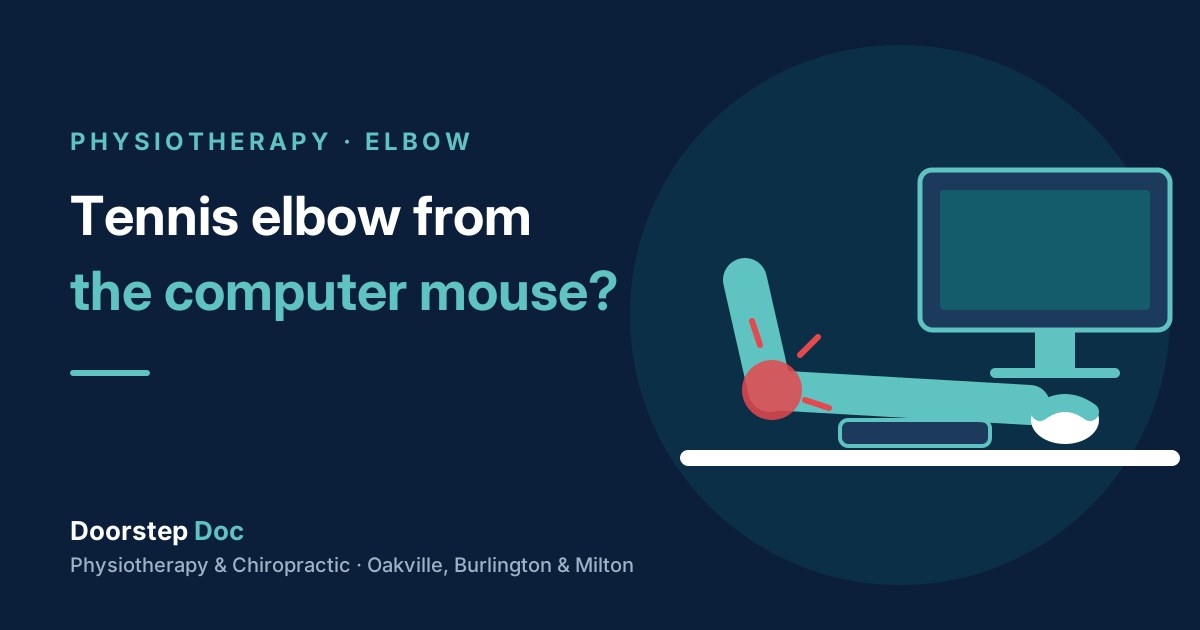
Despite the name, most people who get tennis elbow don't play tennis. Plenty of them do spend long hours with a hand on a mouse, though. If the outside of your elbow aches when you lift the kettle, shake hands or close a laptop at the end of the day, this one's for you.
Tennis elbow physiotherapy is mostly about two things: calming the sore tendon down with hands-on treatment, and then building it back up so it can handle your workday again. Below I'll explain how computer work can contribute, what I do at a home visit in Oakville, and the exercises I often start with.
How a desk job can add to tennis elbow
Tennis elbow, or lateral elbow tendinopathy, is an overload problem. Forceful gripping, repetitive work and handling tools are the best-known risk factors, and long hours on a mouse can add to the load. The muscles that lift your wrist and fingers attach to a small bony bump on the outside of your elbow. When those tendons are asked to do more than they're ready for, day after day, they get irritated and sore.
At a computer, the usual culprits are:
- A mouse that's too far away, so your arm reaches all day
- A wrist bent back while you type or scroll
- Gripping the mouse harder than you need to (most of us do)
- Long stretches without a break, especially during busy weeks
- A laptop on the couch or kitchen table, with your forearms unsupported
Often it's a combination. A big deadline at the office in the Uptown Core, then a weekend of painting the basement or raking in Joshua Creek, on top of an arm that was already busy. The elbow doesn't care which job tipped it over.
Not every sore elbow is tennis elbow, though. Pain on the outside of the elbow can also come from the neck or an irritated nerve, especially if there's tingling or numbness. That's one of the first things I check.
What tennis elbow physiotherapy looks like at home in Oakville
Many people assume physio is just exercises. A good part of my visits is hands-on.
Assessment
I'll ask what you do all day, when it hurts and what eases it. Then I test your grip, how your wrist and elbow move, and where it's tender. I also check your neck and shoulder, because they can contribute to elbow pain or change how you use your arm.
Hands-on treatment
Joint mobilization of the elbow, soft tissue work on the forearm, and sometimes treatment of the neck or upper back if they're stiff. The current physiotherapy clinical practice guideline for lateral elbow pain supports elbow mobilization for short-term pain relief and better pain-free grip, and many people find it makes the exercises much easier to do. Acupuncture is another option I sometimes use for pain, if you'd like to try it; it's always optional. You can read more on my acupuncture page.
Exercise
This is the part that helps the tendon get stronger. Hands-on care gets things moving; exercise is what keeps them moving.
A look at your desk
Because I come to your home, I can see the actual chair, mouse and laptop instead of guessing. For some people, a two-minute tweak to where the mouse sits makes a real difference.
Tennis elbow exercises I often start with
These are common starting points, not a prescription. If any of them make your pain sharply worse, stop and get it assessed. A bit of discomfort while you do them is usually fine, as long as it settles by the next morning.
- Wrist extension hold. Rest your forearm on a table, palm down, hand over the edge. Put your other hand on the back of it and gently push the sore hand up into it, without letting it move. Hold for about 30 to 45 seconds, rest, and repeat 4 or 5 times. Holds like this are often the easiest way to start when everything else hurts.
- Slow wrist lifts. Same position, holding a full water bottle or a can of soup. Lift your wrist up, then lower it slowly over about three seconds. Start with 2 or 3 sets of 10 to 15. When that gets easy, use something heavier.
- Forearm twists. Hold a hammer near the head, elbow bent at your side. Slowly turn your palm up, then down. Move your hand further down the handle as you get stronger.
- Shoulder blade rows. With a resistance band around a door handle, pull your elbows back and squeeze your shoulder blades together. A stronger shoulder and upper back can help share the load, so your forearm isn't doing all the work.
The step-by-step tennis elbow exercises page has illustrations and a few more options.
Small changes at your desk
- Bring the mouse close, right beside the keyboard, so your elbow stays near your side
- Rest your forearm on the desk or an armrest instead of holding it in the air
- Hold the mouse loosely. If your knuckles are white, you're working too hard
- Learn a few keyboard shortcuts to cut down on clicking
- Set a reminder to stand up and shake out your arms every so often
- Some people find a vertical mouse more comfortable. It's worth a try, not a must-buy
Do braces and injections help?
A forearm strap (counterforce brace), worn a couple of finger-widths below the elbow, may ease pain while you're using your arm. The evidence for it is mixed beyond the short term, so I treat it as a helper, not the plan.
Cortisone shots can ease pain quickly, but in one large trial, people who had them were more likely to have their pain come back within a year. If you're considering one, talk it through with your doctor.
How long does it take?
Fair warning: tennis elbow is often slow. Tendons don't like being rushed, and for some people it hangs around for many months, even a year or more. Steady, gradual loading is generally recommended over resting it completely. Most people can keep working while they recover, with a few changes.
Get medical help right away if your elbow is red, hot and swollen, especially with a fever; if you hurt it in a fall and it's misshapen or you can't bend or straighten it; if you feel a sudden pop with bruising or a bulge at the front of the elbow or upper arm; or if arm pain comes with chest pain, shortness of breath or sweating (call 911).
See your doctor promptly for numbness, tingling or weakness in your hand, neck pain that spreads down your arm, pain that's constant at night no matter what you do, or elbow pain with unexplained weight loss or feeling unwell.
Physio, chiro or both
Doorstep Doc is a family-run practice. I'm the physiotherapist, and Dr. Alex Greyvenstein is the chiropractor. We both treat tennis elbow at home with hands-on care and exercise: I visit homes in Oakville, and Dr. Alex visits Oakville, Burlington and Milton. Chiropractic adjustments are Dr. Alex's department; my treatment doesn't include them. Some people see one of us, some see both. The tennis elbow treatment page covers both approaches, and you can read more about in-home physiotherapy in Oakville.
If you're not sure which fits, the free 15-minute phone call is a chance to ask your questions and work out whether physio, chiro or both makes sense. When you're ready, book a home visit.
Common questions
How long does tennis elbow take to heal with physiotherapy?
It varies a lot. Some people improve within a few weeks, while for others it lasts many months or longer. Tendons respond slowly, so a steady plan of hands-on treatment and gradually heavier exercise, plus changes to whatever overloaded the elbow, is generally recommended over complete rest.
Should I wear a tennis elbow brace?
A forearm strap worn just below the elbow may ease pain while you're using your arm. The evidence beyond the short term is mixed, so it works best as a helper alongside exercise and changes to your work setup, not as the whole plan.
Do I need to stop using the computer?
Usually not. Most people keep working with a few changes: the mouse closer, forearms supported, a looser grip and regular breaks. Your physiotherapist can help you find which tasks to ease off and how to build back up.
Can tennis elbow come from my neck?
Pain on the outside of the elbow can sometimes come from the neck or an irritated nerve, especially with tingling, numbness or neck pain. That's why a physio assessment for elbow pain includes your neck and shoulder.
Do I need a referral to see a physiotherapist for tennis elbow in Ontario?
No. You can book directly with a physiotherapist in Ontario. Some extended health plans ask for a doctor's note before they reimburse physiotherapy, so check your plan's details.