
Headaches
Tension Headache vs Migraine: How to Tell the Difference
 By Dr. Alex Greyvenstein, DC6 min read
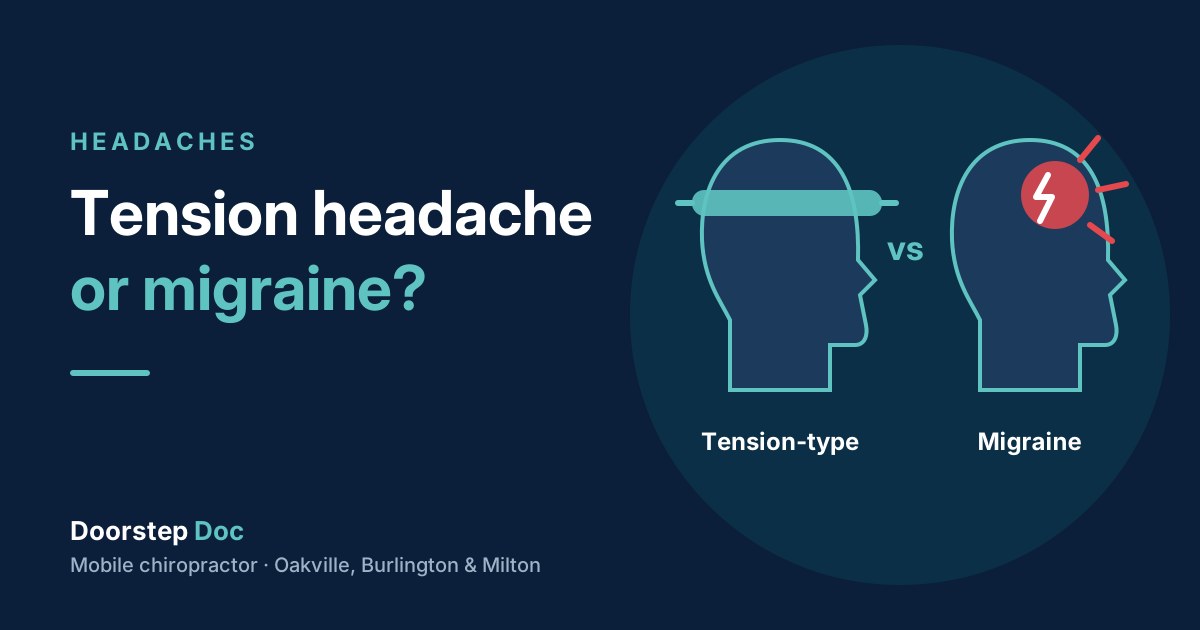
Two people can both say "I've got a headache" and mean completely different things. One has a dull band squeezing their forehead after a long afternoon of spreadsheets. The other is lying in a dark bedroom, curtains shut, hoping nobody in the house starts vacuuming. That's the difference between a tension headache and a migraine, and knowing which one you're dealing with changes what's likely to help.
A lot of people around Oakville ask me how to tell them apart, so this post covers the clues I look at, where the neck fits in, what you can try, and the headaches that need a doctor before they need me.
Tension headache vs migraine: the quick version
Doctors use a set of criteria from the International Classification of Headache Disorders to tell these apart. You don't need to memorize them, but the pattern is useful.
A tension-type headache usually:
- Feels like pressure or tightness, often described as a band or a vice, rather than throbbing
- Sits on both sides of the head: the forehead, temples, or the back of the head and neck
- Is mild to moderate. Annoying, but you can usually keep going
- Doesn't get worse when you walk around or climb the stairs
- Comes without nausea. Light or noise might bother you a bit, but not both
- Lasts anywhere from half an hour to several days
A migraine usually:
- Throbs or pulses
- Is often on one side of the head, though it can be on both
- Is moderate to severe, enough to stop you in your tracks
- Gets worse with ordinary activity, so even walking to the kitchen feels like a bad idea
- Comes with nausea or vomiting, or with sensitivity to both light and sound
- Lasts roughly 4 hours to 3 days if it isn't treated
It's the overall picture that counts, and plenty of people get both.
What about aura?
Some people with migraine get a warning before the headache, called an aura. It's often visual: zigzag lines, shimmering spots or a blind patch that slowly spreads. Some people get tingling that creeps up a hand into the face, or have trouble finding words. Aura usually builds over several minutes and fades within an hour. Most people with migraine never get one, so no aura doesn't mean no migraine.
If you've never had an aura and you suddenly lose vision, can't get your words out, or notice weakness or numbness on one side, don't assume it's a migraine. The same goes for an aura that's different from your usual, lasts more than an hour, or comes with weakness. Those can also be signs of a stroke. Call 911.
Common triggers
Tension-type headaches tend to follow long stretches at a screen, stress, short nights, skipped meals, not drinking enough water, clenching your jaw and squinting at a laptop that's too far away. The classic one I hear about is the day that started with an early GO train, ran through back-to-back video calls and ended with a crawl along the QEW.
Migraines are often linked to changes: in sleep, in hormones (around a period, for example), in routine, even the weekend after a stressful week. Skipped meals, alcohol, strong smells and bright or flickering light are common triggers too.
The most useful thing you can do is keep a headache diary for a few weeks: the date and time, what it felt like, where it was, what you'd been doing, how you slept, what you ate and what you took for it. Not as fun as a holiday journal, but far more useful.
Where your neck comes in
Neck and shoulder tension shows up with both types. With tension-type headaches, the muscles around the neck, shoulders and scalp are often tight and tender. With migraine, neck pain is common too, sometimes before the headache starts, and that doesn't automatically mean the neck is the cause.
There's also a third type, the cervicogenic headache, which starts in the neck itself. That one deserves its own post, but it's another reason a proper assessment beats guessing.
A word about painkillers
Painkillers are useful, but using them on a lot of days can backfire. Taking simple painkillers like ibuprofen or acetaminophen on 15 or more days a month, or triptans or combination painkillers on 10 or more days a month, for more than three months, can lead to medication-overuse headache. If that sounds like you, talk to your doctor or pharmacist. Don't just stop a prescription medication on your own.
What can help a tension-type headache
For a lot of people, small changes add up:
- Break up screen time. Stand up, roll your shoulders and look out the window for a minute every so often. Setting a timer works better than good intentions.
- Raise the screen. A laptop flat on the kitchen table pulls your head forward for hours. A stand or a stack of books and a separate keyboard can help.
- Cover the basics. Regular meals, water and decent sleep sound boring because they are, but they matter.
- Try gentle neck and shoulder-blade exercises. Chin nods and shoulder blade squeezes are a good start. The neck pain exercises page walks through them.
- Use heat. A warm shower or heat pack on the neck and shoulders can ease tight muscles.
The current Canadian chiropractic guideline on headaches linked to neck pain points to education and low-load neck and shoulder-blade exercises for tension-type headaches. It doesn't recommend neck adjustments for the episodic kind. So I usually start with education and those exercises, and may add soft tissue work or gentle mobilization if it helps you move more comfortably.
And migraine?
If your headaches sound like migraine, your family doctor is the first stop. There are good medications for treating attacks and for preventing them, and that's their territory, not mine. Where I may be able to help is with the neck and shoulder tension that often comes along for the ride, along with sleep setup, desk habits and regular exercise. I won't promise fewer migraines.
Call 911 or go to the ER for a sudden, severe headache that peaks within about a minute or feels like the worst of your life; a headache with face drooping, arm or leg weakness, numbness, trouble speaking or swallowing, confusion, vision loss or double vision, sudden dizziness, or loss of balance or coordination; a new, unusual neck pain and headache after a minor neck injury or sudden twist, especially with any of those signs; a headache with fever, a stiff neck or a rash; a headache after a head injury; or a headache with a seizure or fainting.
See your doctor promptly for a new headache if you're over 50; headaches that are changing pattern or getting steadily worse; headaches that wake you up or get worse when you lie down, cough or strain; a new headache during pregnancy or soon after; a headache with a history of cancer or a weakened immune system; scalp tenderness or jaw pain when chewing if you're over 50; or a painful red eye with blurred vision.
Headache care at home in Oakville
When I see someone for headaches, I start with the story: when your headaches started, what they feel like, what sets them off and what you've tried. Then I look at how your neck, upper back and jaw move, check strength, reflexes and sensation, and screen for anything that needs a medical doctor instead. If chiropractic care is a good fit, we'll make a plan together. The headache treatment page has more detail.
Because I come to you, whether that's Bronte, River Oaks, Clearview or the Uptown Core, I can see the desk, the laptop and the pillow that might be part of the problem. Visits are 30 minutes in total, including setup, with about 20 to 25 minutes of hands-on time. Helena Greyvenstein, our physiotherapist, also treats headaches linked to the neck, if physiotherapy at home suits you better.
Not sure whether your headaches are something I can help with? The free 15-minute phone call is a good place to ask. When you're ready, book a home visit.
Common questions
How can I tell if it's a tension headache or a migraine?
A tension-type headache usually feels like pressure or a tight band on both sides of the head, is mild to moderate, and doesn't get worse with walking or stairs. A migraine usually throbs, is often on one side, is moderate to severe, gets worse with activity, and comes with nausea or sensitivity to both light and sound. Your family doctor can confirm which you have.
Where is a tension headache usually felt?
On both sides of the head, often across the forehead, around the temples or at the back of the head, sometimes spreading into the neck and shoulders. Many people describe it as a tight band or a vice.
Can you have tension headaches and migraines?
Yes. Many people with migraine also get tension-type headaches, which is one reason a headache diary is so useful. It helps you and your doctor see which headaches are which and what tends to set them off.
Can a chiropractor help with tension headaches?
For tension-type headaches, current Canadian guidance points to education and gentle neck and shoulder-blade exercises, and doesn't recommend neck adjustments for the episodic kind. A chiropractic assessment can look at your neck, upper back, jaw and daily habits, and treatment may include exercises, soft tissue work and gentle mobilization. It doesn't suit everyone, and I'll tell you if your headaches need a doctor first.
When should I worry about a headache?
Call 911 for a sudden, severe headache that peaks within about a minute, or a headache with face drooping, weakness, numbness, trouble speaking, confusion, vision loss, fever with a stiff neck, or after a head injury. See your doctor promptly for a new headache after 50, headaches that are changing or getting worse, or headaches that wake you up.